Chapter Twenty-Two: Introduction to Disorders of Osmolality
Chapter Twenty-Two: Introduction to Disorders of Osmolality
Edited by Nayan Arora
References
This is the famous Edelman equation from JCI in 1958 by Isodore Edelman! Interrelations between serum sodium concentration, serum osmolarity and total exchangeable sodium, total exchangeable potassium and total body water (not to be confused by Isildur House of Isildur - Tolkien Gateway
Joel mentioned his slide deck on Edelman: https://pbfluids.com/wp-content/uploads/2023/04/QN_III-The-Edelman-Equation-full-lecture-from-2020-07-30.pdf
This is an excellent review (with great figures) on Osmotic homeostasis by Danziger and Zeidel in CJASN
Joel and JC mentioned the work from Joseph Verbalis on hyponatremia- this is an excellent review that includes population data from NHANES plus striking images of the osteopenic bones in hyponatremic rats! Check this out! Hyponatremia‐induced osteoporosis - Verbalis - 2010 - Journal of Bone and Mineral Research - Wiley Online Library
Joel and JC mentioned “reference 2” from the chapter by Kleeman and others on diuretic induced hyponatremia which invoked hypokalemia as an important player: Diuretic-Induced Hyponatremia | Annals of Internal Medicine
We couldn't help flirting with diarrhea a little Secretory diarrhoea: mechanisms and emerging therapies - PMC
We talked about cravings for those with salt losses and here’s one example Gitelman syndrome in a South African family presenting with hypokalaemia and unusual food cravings - PMC
PBFluids classic: Saltiest Sodium. Dumbest Dude
Volume Depletion versus Dehydration: How Understanding the Difference Can Guide Therapy here’s one of many articles that argues for choosing language wisely.
Amy’s VOG references:
PMC3041494
42321668
41846300
42195166
33374011
PMC3041494
PMC12884999
3102222
42060832
41201721
32401639
Link to Goljian Physiology Spotify! Episode 2 is Fluid and Hemodynamics: https://open.spotify.com/show/1uD6090Kkg01b4zr2ouNiM?si=e7f609e0d9634840
Outline: Chapter 22
Introduction to Disorders of Osmolality
Hyponatremia and hypernatremia are common clinical problems
Reflect abnormalities of water balance that may or may not be accompanied by changes in Na balance
Water Distribution and Osmotic Pressure
TBW makes up 60% of lean body weight in men
50% of lean body weight in women
60% intracellular
40% extracellular
One-fifth of extracellular water is in the intravascular space
Breakdown
70 kg man
TBW = 42 L
25 L intracellular
17 L extracellular
3 L of the 17 L is intravascular
Osmotic forces determine the distribution of water
Each compartment has one major solute that holds water within the compartment
Na → extracellular compartment
K → intracellular compartment
Plasma proteins → plasma space
Urea is an ineffective osmole
Physiologic Effects of Changes in Plasma Osmolality
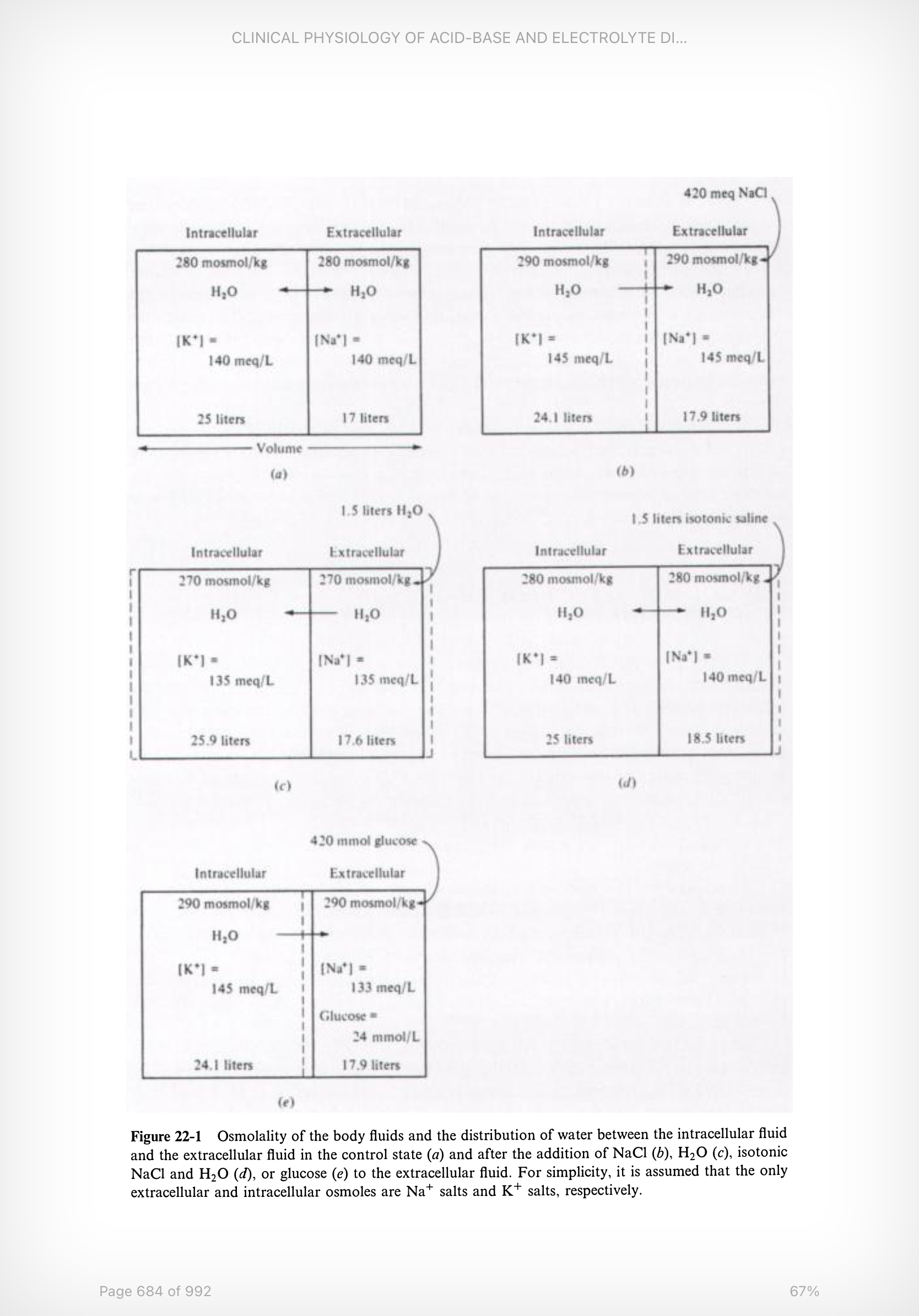
Figure 22-1
Na pulls water from the intracellular compartment
Increases extracellular volume
Decreases intracellular volume
Even though Na is locked in the extracellular compartment
Administering Na increases osmolality everywhere by changing water distribution
Increases extracellular volume
Decreases intracellular volume
Example
Adding 210 mEq Na to 17 L ECF would mathematically increase concentration by 12.5 mEq/L (210/17)
Actually only raises serum Na by ~5
Water moves from cells
Na remains trapped in ECF
Ultimately diluted in TBW
210/42 L = 5 mEq/L
Adding water
Expands both compartments
Dilutes osmolality in both compartments
Giving isotonic saline
Expands extracellular compartment only
Does not change intracellular volume
Changes in osmolality and intracellular volume
Responsible for symptoms of hypo- and hypernatremia
In these examples
Extracellular volume is increased
Sodium concentration may be high, low, or normal
Meaning of Plasma Sodium Concentration
Na, glucose, and urea are the primary extracellular osmoles
Gives osmolality calculation
Under normal conditions
Glucose and BUN contribute <10 mOsm/L
Therefore
Plasma osmolality ≈ 2 × plasma Na
Hypernatremia represents hyperosmolality
Hyponatremia usually reflects hypo-osmolality
Exception: hyperglycemia
Plasma Sodium Concentration and Total Body Osmolality
If plasma Na reflects plasma osmolality
And plasma osmolality is in equilibrium with total body osmolality
Then plasma Na reflects total body osmolality
Since
Total body osmolality = (ECF solutes + ICF solutes) / TBW
And
Na and K (plus accompanying anions) are the major extracellular and intracellular solutes
Then
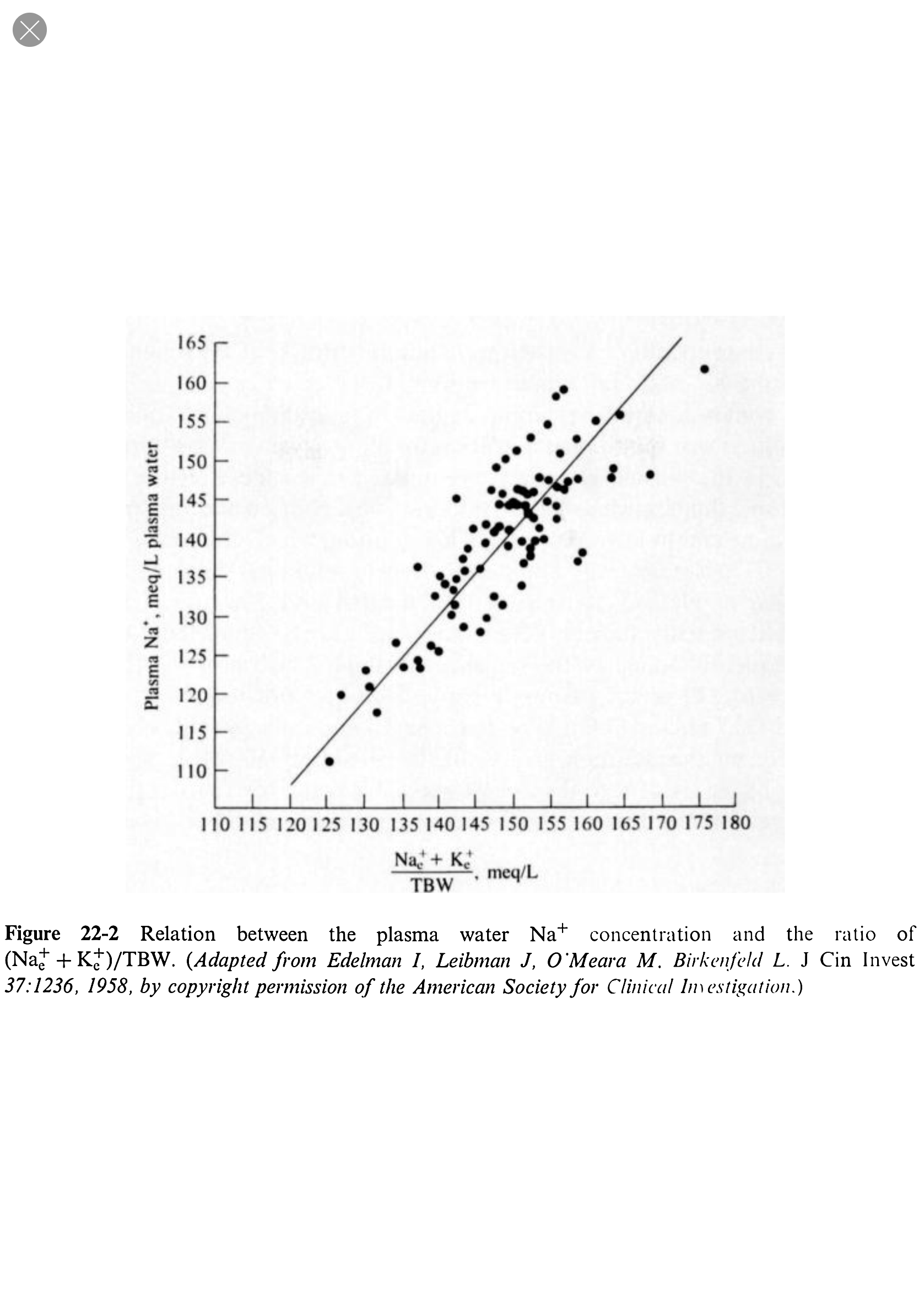
Plasma Na ≈ (Na + K) / TBW
Figure 22-2
Key Edelman figure
Loss of potassium
K moves out of cells
To maintain electroneutrality
Na enters cells
Lowers serum Na
Or Cl leaves with K
Lowers intracellular osmolality
Water moves from cells to ECF
Dilutes serum Na
Or extracellular H dissociates from buffers and enters cells
Combines with intracellular buffers
No net movement of solute
Water still leaves cells
Serum Na diluted
Suggests K loss is responsible for much diuretic-induced hyponatremia (Ref 2)
DKA example
0.45% NS with 40 mEq KCl is insufficient to correct hyperosmolality
Hyponatremia and Hypernatremia
Can result from alterations in
Na
K
Water
Usually due to water abnormalities
Exception
Thiazides
Loss of both Na and K contributes
Toxicity of K prevents excess K from producing hypernatremia
Diarrhea
Isosmotic to plasma
Ionic composition varies
Secretory diarrhea (cholera)
Na + K approximately equals plasma Na
Causes volume depletion
Does not cause hypernatremia
Osmotic diarrhea
Fecal Na + K between 30 and 110
Nonreabsorbed solutes account for remainder
Causes hypernatremia
Diarrheal illness
Often causes fever
Increases insensible losses
Also stimulates ADH and thirst
Usually water balance remains near normal
Infants commonly become hypernatremic
Regulation of Plasma Osmolality
Daily variation in water intake and loss alters plasma osmolality
Water intake
Drinking
Water content of food
Water of oxidation
Carbohydrates metabolized to CO2 and H2O
Water retention lowers plasma osmolality
Water loss
Urine
Feces
Skin
Respiratory tract
Water loss raises plasma osmolality
Water intake and excretion are tightly regulated
Osmoreceptors in hypothalamus
After water load
Plasma osmolality falls
ADH release inhibited
Urinary water loss increases
Hyperosmolality
Stimulates thirst
Stimulates ADH
Increases water intake
Decreases water loss
Regulation disrupted by
Neurologic disorders
Hypothalamus
Posterior pituitary
Renal disorders
Impaired concentrating or diluting ability
Nonosmotic stimuli
Volume depletion
Osmoregulation versus Volume Regulation
Table 22-2
Plasma osmolality
Ratio of solute to water
Extracellular volume
Determined by absolute amount of Na and water
Two examples
Exercising on a hot day
Loss of dilute sweat
↑ Plasma osmolality (Na)
↓ Extracellular volume
SIADH
↓ Plasma osmolality (Na)
↑ Extracellular volume
Nice exercise at bottom of page 691
Isotonic saline
Does not change osmolality
Hypothalamus not activated
Increased volume suppresses renin
Increases ANP
Water load
Inhibits ADH
Produces dilute urine
Rapid restoration of volume
Only transient volume expansion
Little effect on renin or ANP
NaCl without water
Expands extracellular volume
Stimulates renal NaCl loss
Also stimulates thirst and ADH
Produces small volume of concentrated urine
Similar to intake
Volume Depletion versus Dehydration
They are not synonyms
Urine Osmolality and Specific Gravity
Relation Between Intake and Output
Simply comparing ins and outs is inadequate
Composition of fluids may differ markedly
Replacing urinary losses with free water
Produces hyponatremia