Chapter Twenty-Three: Hypoosmolal States–Hyponatremia part 2 of 3
Chapter Twenty-three: Hypoosmolal States–Hyponatremia part 2
Edited by Nayan Arora
References
This is the thiazide induced hyponatremia reference mentioned by Friedman: Thiazide-Induced Hyponatremia: Reproducibility by Single Dose Rechallenge and an Analysis of Pathogenesis
This is the study that Josh mentioned regarding genetic predisposition Phenotypic and pharmacogenetic evaluation of patients with thiazide-induced hyponatremia and it was considered by Neph JC too Thiazide induced hyponatremia, a detailed phenotypic and genotypic analysis
And here’s a great review: Thiazide-Associated Hyponatremia: Clinical Manifestations and Pathophysiology - American Journal of Kidney Diseases in this excellent review, nice summary of the potential effect of female sex on NCC density (at least in rats!)
Melanie wanted to clarify the term “desalination.” Here are a few references:
• Postoperative hyponatremia despite near-isotonic saline infusion: a phenomenon of desalination Mitch Halperin 10.7326/0003-4819-126-1-199701010-00003
• Ewout Hoorn refers to “Desalination” here Current and future treatment options in SIADH - PMCHere’s the abstract that Amy mentioned: Abstract P174: Incidence of Hyponatremia on Spironolactone in Patients With a Prior Episode of Chlorthalidone-Induce Hyponatremia
We mentioned the issue of solute intake again and this favorite reference: Impact of solute intake on urine flow and water excretion
Joel alluded to the unsteady gait from this paper that did the “total traveled way” and showed unsteady gait: Mild Chronic Hyponatremia Is Associated With Falls, Unsteadiness, and Attention Deficits - ScienceDirect and the effect on bones: Hyponatremia-Induced Osteoporosis - PMC (this paper is a beauty, if you don’t like it, we can’t be friends!)
For the mechanisms of hyponatremia in hypoadrenalism, Mel reviewed the mechanisms here and there is a good image too: Pattern Recognition versus Pathogenesis - PMC and you may also like this review from Schrier: Role of Glucocorticoid Hormones in Arginine Vasopressin Gene Regulation - ScienceDirect and mel mentioned Osmoregulation of plasma vasopressin in myxedema
Amy mentioned this reference: The contribution of undiagnosed adrenal insufficiency to euvolaemic hyponatraemia: results of a large prospective single-centre study
Some musings we (especially Josh and JC) had about SIADH: Vasopressin and oxytocin release during prolonged environmental hypoxia in the rat, Urinary output and plasma levels of antidiuretic hormone during intermittent positive-pressure breathing in the dog, A Vasopressin-Induced Change in Prostaglandin Receptor Subtype Expression Explains the Differential Effect of PGE2 on AQP2 Expression,Pathogenesis of hyponatremia in an experimental model of the syndrome of inappropriate antidiuresis, Atrial natriuretic peptide in patients with the syndrome of inappropriate antidiuretic hormone secretion and with diabetes insipidus
Here’s a reference on fetal vs maternal sodium gradient: Fetal diuretic responses to maternal hyponatremia: contribution of placental sodium gradient | Journal of Applied Physiology
Roger mentions the nephrogenic syndrome of antidiuresis: Nephrogenic Syndrome of Inappropriate Antidiuresis - PMC
The NEJM manuscript looking at water dilution in schizophrenia: Mechanisms of Altered Water Metabolism in Psychotic Patients with Polydipsia and Hyponatremia
Tragic case of water loading Woman dies after being in water-drinking contest - Los Angeles Times
The case report that Josh mentioned: Self-induced water intoxication without predisposing illness
Roger mentioned this case: Who killed Bruce Lee? The hyponatraemia hypothesis - PMC and this classic from NEJM: Mechanisms of Altered Water Metabolism in Psychotic Patients with Polydipsia and Hyponatremia | NEJM
Pseudohyponatremia- check out this cute video from laboratorian Joseph El-Khoury: Episode 1 (Pilot): Ending Pseudohyponatremia and here’s a great picture that helps illustrate the issue of measuring the sodium when the solid phase is larger in the plasma: https://i0.wp.com/nephsim.com/wp-content/uploads/2019/02/PseudoHyponatremia1.png?resize=768%2C564&ssl=1
And here’s an instructive case: Electrolyte Abnormalities in a Man With Plasma Cell Leukemia - American Journal of Kidney Diseases

Amy’s VoG on Legionella and Hyponatremia
association with hyponatremia
first description: https://pubmed.ncbi.nlm.nih.gov/434629/
https://pubmed.ncbi.nlm.nih.gov/6997673/
low UrNa as mechanism of hyponatremia?
https://pubmed.ncbi.nlm.nih.gov/6802400/
Diagnosis with serology and Winthrop criteria
sensitivity and specificity if the Winthrop criteria https://pubmed.ncbi.nlm.nih.gov/11591540/
modified criteria https://pubmed.ncbi.nlm.nih.gov/18410967/
atypical pneumonia diagnosis https://pubmed.ncbi.nlm.nih.gov/8493198/
Association with hypophosphatemia
https://pubmed.ncbi.nlm.nih.gov/6997673/
Chapter 23: Hypoosmolar States — Hyponatremia
Diuretics
Mild hyponatremia is a common complication of diuretic therapy.
Acute severe hyponatremia may occur as an idiosyncratic reaction, particularly in patients drinking large volumes of water.
Thiazide-Associated Hyponatremia
The classic 1989 Friedman data:
13 patients with a history of thiazide-associated hyponatremia.
A single 50-mg dose of HCTZ produced an acute fall in serum Na.
Increased water drinking appeared to contribute.
Additional mechanisms include:
Volume depletion
Potassium depletion
Direct inhibition of urinary dilution through decreased NaCl reabsorption
If excessive water intake is important:
Uric acid may be low.
BUN may be low.
Clinically significant diuretic-associated hyponatremia is almost always associated with thiazides rather than loop diuretics.
Why Thiazides Are Different
Loop diuretics:
Reduce the hypertonicity of the medullary interstitium.
Impair the kidney’s ability to concentrate urine.
Can therefore actually be used as part of the treatment of SIADH.
Thiazides:
Do not disrupt the medullary concentration gradient in the same way.
Impair urinary dilution.
Can promote Na and K loss in excess of water.
One cited example:
Urine Na + K = 156 mEq/L
Plasma Na <110 mEq/L
This is desalination: urinary fluid contains more effective cation than the plasma, so its loss can further lower serum sodium.
In susceptible patients:
Serum Na can begin falling within 6–24 hours.
Most cases occur within 2 weeks of starting a thiazide.
The largest physiologic effect occurs with the earliest doses.
After several weeks, patients generally reach a new steady state.
Renal Failure
Renal failure impairs the ability to maximally dilute urine after a water load.
Potential mechanism:
Osmotic diuresis in the remaining nephrons
Severe hyponatremia is relatively uncommon when patients remain non-oliguric.
Risk increases as GFR approaches zero.
SYNDROME OF INAPPROPRIATE ADH SECRETION
Introduction
SIADH is:
Common
Associated with a wide range of clinical conditions
Characterized by nonphysiologic ADH activity
An unusual physiologic state in which water excretion is impaired while Na excretion remains relatively intact
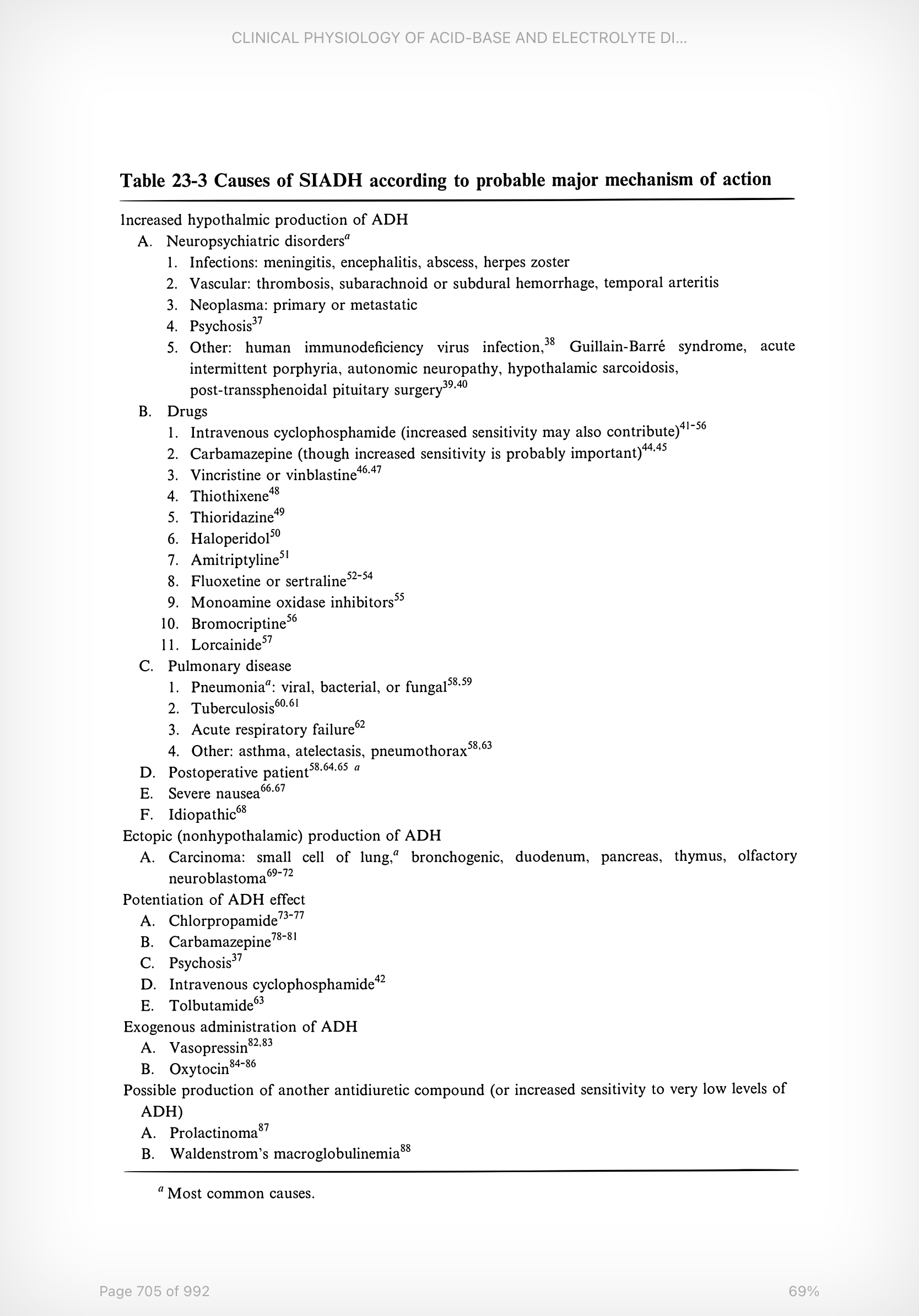
See Table 23-3.
Pathogenesis
See Figure 23-3.
Ingested water is retained because of ADH-mediated effects on the kidney.
Yet patients generally do not develop edema because sodium remains in balance.
The combination of:
Water retention
Sodium excretion
…produces hyponatremia.
In chronic SIADH, sodium loss may become as important as or more important than the initial water retention.
Potassium Loss
Hyponatremia causes cellular swelling.
Cells adapt by ejecting intracellular solutes, including:
Potassium
The released potassium is subsequently excreted by the kidney.
Chronic Adaptation
A new steady state develops over approximately a couple of weeks.
At steady state:
Na intake = Na output
Contributing mechanisms include:
Relative ADH resistance
Reduced urine osmolality
Reduced aquaporin expression
Importantly, water ingestion remains essential. Without water intake, SIADH cannot produce hyponatremia.
Patterns of ADH Secretion in SIADH
Four patterns are described.
Type A — Erratic ADH Secretion
ADH secretion is essentially independent of osmotic regulation.
Type B — Reset Osmostat
ADH retains its normal relationship with plasma osmolality.
The entire relationship is shifted to a lower set point.
Serum Na is often relatively stable around 125–130 mEq/L.
Patients may appropriately dilute their urine in response to a water load once they reach their lower osmotic set point.
Type C — Failure to Completely Suppress ADH
ADH regulation appears normal around normal plasma osmolality.
But ADH cannot be completely suppressed when plasma osmolality falls.
Type D — Normal Measured ADH
Possible explanations:
Increased renal sensitivity to ADH
Another unidentified antidiuretic factor
Acid-Base and Potassium Balance in SIADH
Interesting question:
Why does Na become diluted without equivalent dilution of K or bicarbonate?
Potential mechanisms:
H moves into cells.
Renal H clearance increases.
ADH directly stimulates H secretion.
Dilutional hypokalemia is partly prevented by movement of intracellular K out of cells.
Hypokalemia can occur, particularly when plasma osmolality falls below approximately 240 mOsm/kg.
ETIOLOGY OF SIADH
SIADH can result from:
Increased hypothalamic ADH production
Ectopic ADH production
Potentiation of ADH’s renal effect
Exogenous ADH or related hormones
CNS / Neuropsychiatric Disease
Neuropsychiatric disorders can promote ADH release:
Directly
Through cortical neuronal pathways stimulating the hypothalamus
Examples:
Approximately 20% of patients with subarachnoid hemorrhage
Approximately 20–35% after transsphenoidal pituitary surgery
Adrenal insufficiency may contribute following pituitary surgery.
Psychiatric patients may have abnormalities at several levels:
Water intake
ADH secretion
Renal responsiveness to ADH
Again, much water intake is habitual rather than thirst-driven.
HIV
Hyponatremia has been reported in approximately 40% of patients with HIV infection.
Potential mechanisms include:
Volume depletion
Adrenal insufficiency
SIADH
Pneumocystis pneumonia
Malignancy
CNS disease
Drugs
Many drugs have been associated with SIADH, although most only rarely produce clinically significant hyponatremia.
Cyclophosphamide
Increases renal sensitivity to ADH.
Particularly associated with IV rather than oral administration.
Patients are often instructed to drink large quantities of water because of concern for hemorrhagic cystitis.
Severe and occasionally fatal hyponatremia has occurred.
Chlorpropamide
Oral hypoglycemic agent.
Increases NaCl reabsorption in the TAL.
Increases sensitivity to ADH.
NSAIDs
Increase the renal action of ADH.
Mechanism: inhibition of renal prostaglandin synthesis.
PGE normally antagonizes ADH activity.
NSAIDs alone rarely cause severe SIADH but can worsen pre-existing hyponatremia, particularly with concomitant volume depletion.
Pulmonary Disease
Associated conditions include:
Pneumonia
Asthma
Atelectasis
Emphysema
Pneumothorax
Tuberculosis
Acute respiratory failure
Possible mechanism:
Reduced pulmonary venous return may activate volume receptors.
Some patients therefore have a low urine sodium.
Reset osmostat has been described with tuberculosis.
Major Surgery
Transient SIADH may occur for 2–5 days after major surgery.
Pain afferents can directly stimulate hypothalamic ADH secretion.
Ectopic ADH Production
Classic association:
Small-cell carcinoma of the lung
Exogenous ADH and Oxytocin
Oxytocin:
Is synthesized by the hypothalamus.
Normally regulates uterine function and lactation.
Also possesses meaningful antidiuretic activity.
Administration during pregnancy has caused hyponatremic seizures in both mother and fetus.
Practical considerations:
Avoid administering large amounts in D5W.
Prefer isotonic saline when appropriate.
Limit unnecessary water intake.
Other ADH-related therapies mentioned:
Vasopressin for GI bleeding
DDAVP for:
Nocturia
Platelet dysfunction
Central diabetes insipidus
Idiopathic SIADH
Occasionally no cause is identified.
Consider:
Occult malignancy
Temporal arteritis
These patients may have low serum uric acid because of increased urinary uric acid clearance.
CEREBRAL SALT WASTING
Rare syndrome associated with cerebral disease, particularly:
Subarachnoid hemorrhage
Phenotype:
Hyponatremia
High urine Na
Low serum uric acid
Volume depletion
Volume depletion is the key proposed distinction from SIADH.
A theoretical factor released from the injured brain may cause:
Renal salt wasting
Uric acid wasting
BNP has been proposed as one candidate.
ADRENAL INSUFFICIENCY
Hyponatremia is common in adrenal insufficiency.
Separating the contributions of:
Cortisol deficiency
Volume depletion
…can be difficult.
Cortisol replacement can rapidly normalize serum sodium.
The mechanism appears strongly ADH-mediated because ADH antagonism can reverse the defect.
ADH is co-secreted with CRH. Cortisol normally provides negative feedback on both:
Cortisol ↓ → CRH ↑ → ADH ↑
HYPOTHYROIDISM
Hypothyroidism is often listed in the differential diagnosis of hyponatremia, but it is actually a rare cause of clinically significant hyponatremia.
RESET OSMOSTAT
Patients fulfill many criteria for SIADH but regulate osmolality around a lower set point.
Described in:
Hypovolemic states
Psychosis
Chronic malnutrition
Pregnancy
Possible mechanisms include:
Baroreceptor-mediated ADH stimulation
Altered cellular metabolism in malnutrition
Pregnancy-related hormonal effects
During pregnancy, hCG may promote release of ovarian relaxin.
Potential mechanisms:
Vasodilation → relative effective volume depletion
Direct effects on osmoreceptor regulation
PRIMARY POLYDIPSIA
Occurs in approximately 7% of patients with schizophrenia.
Clinical clues:
Weight gain during the day from water accumulation
Excessive water drinking
Dry mouth from medications
There may also be a central abnormality of thirst regulation, with the osmotic threshold for thirst shifted below the threshold for ADH release.
Examples:
Reported Na 84 mEq/L with Uosm 74 mOsm/kg
Symptomatic hyponatremia after drinking 3–4 L of water while anxiously awaiting a drug test
Severe cases often involve stacked etiologies:
Primary polydipsia
Thiazides
Antipsychotics
Nausea-induced ADH
Stress-induced ADH
Low-solute intake / beer potomania
PSEUDOHYPONATREMIA AND NON-HYPOOSMOLAR HYPONATREMIA
Normal Plasma Osmolality
Classic Pseudohyponatremia
Normally, approximately 930 mL of each liter of plasma is water.
With severe:
Hyperlipidemia
Hyperproteinemia
…plasma water may fall as low as approximately 720 mL/L.
The sodium concentration in the plasma water remains normal, but sodium expressed per liter of total plasma appears low.
Thus:
Measured serum Na is low.
Effective plasma osmolality remains normal.
Direct ion-selective electrodes can identify the true sodium concentration, while methods involving sample dilution may reproduce the artifact.
TURP / Hysteroscopy
Absorption of non-electrolyte irrigation solutions can produce complex abnormalities.
Probably historical enough to skip?
Hyponatremia With Increased Plasma Osmolality
Hyperglycemia
Interesting terminology issue: the chapter refers to hyperglycemia-associated hyponatremia as “pseudohyponatremia.”
The key point is that treatment should target the hyperglycemia, not the sodium concentration itself.
Traditional correction:
Na increases approximately 1.6 mEq/L for every 100 mg/dL fall in glucose.
At very high glucose concentrations, the correction may be closer to:
2.4 mEq/L per 100 mg/dL, particularly above glucose ~400 mg/dL.
Mannitol
Mannitol can cause hyperosmolar hyponatremia.
The amount of circulating mannitol can be estimated using the osmolar gap.
IVIG
Some IVIG preparations contain maltose, which can accumulate and contribute to hyperosmolar hyponatremia.